

Blog
Luxury Artificial Wedding Bouquets UK: The Three Manufacturing Markers That Tell You Whether You’re Actually Buying Luxury Before You Pay

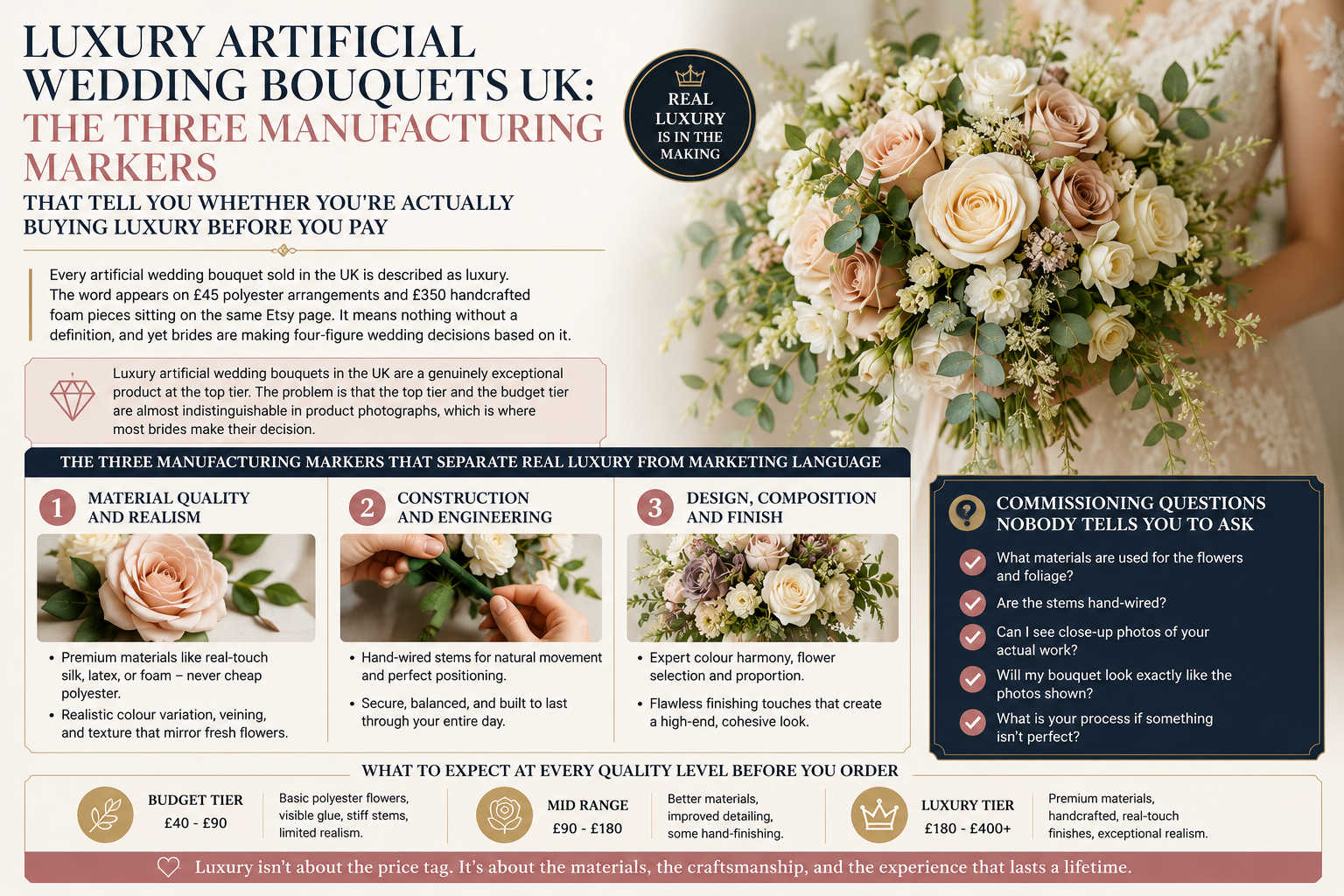
Every artificial wedding bouquet sold in the UK is described as luxury. The word appears on £45 polyester arrangements and £350 handcrafted foam pieces sitting on the same Etsy page. It means nothing without a definition, and yet brides are making four-figure wedding decisions based on it.
Luxury artificial wedding bouquets in the UK are a genuinely exceptional product at the top tier. The problem is that the top tier and the budget tier are almost indistinguishable in product photographs, which is where most brides make their decision. This guide gives you the three manufacturing markers that separate real luxury from marketing language, the commissioning questions nobody tells you to ask, and exactly what to expect at every quality level before you place a single order.
What “Luxury” Actually Means in Artificial Wedding Bouquets and What It Doesn’t
The UK artificial wedding flower market uses “luxury” as a price descriptor rather than a manufacturing specification. That distinction matters enormously, because the price of an artificial bridal bouquet and its actual quality tier are not reliably correlated. I’ve seen £280 polyester bouquets marketed as luxury that look convincingly fake in standard daylight, and £160 handcrafted foam pieces from specialist Etsy makers that experienced photographers consistently mistake for fresh flowers. Real luxury in an artificial wedding bouquet comes down to three manufacturing markers, and every one of them is verifiable before you order:
Marker 1 — Material: PE foam over polyester. Handcrafted PE (polyethene) foam flowers are made petal by petal from thin foam sheets, heat-shaped using metal tools to create curl, veining, and the slight translucency real petals have when held to light. Polyester flowers are moulded in a single piece. The petal surfaces are uniform, reflect light at a single angle, and read as synthetic in photographs. This is the most important single variable. If a supplier cannot tell you whether their flowers are foam or polyester, they are polyester.
Marker 2 — Petal construction: individual vs. moulded. Within foam flowers, there is still a quality range. Machine-produced foam flowers are cut and shaped by automated equipment, consistent but not individually refined. Handcrafted foam flowers are formed by a maker working each petal individually, which produces the subtle irregularities, slight size variation, uneven curl at the edges, and gentle colour gradation that make real petals look real. Ask specifically: “Are the petals individually hand-shaped or machine-cut?”
Marker 3 — Stem construction: wire armature vs. hollow plastic. A luxury artificial bridal bouquet has stems with a weighted wire armature, internal wire wrapped with floral tape that gives the stem the flex and weight of a real cut flower. Hollow plastic stems are rigid, light, and create a fundamentally different hand-feel when holding the bouquet. Brides notice this immediately during the first dance, and during photographs a bouquet that feels hollow and light does not feel like the real equivalent, regardless of how the flowers look. All three markers are verifiable. Ask before you order. Any maker confident in their quality tier will answer specifically.
The Commissioning Mistake That Leaves Brides Disappointed on Delivery Day
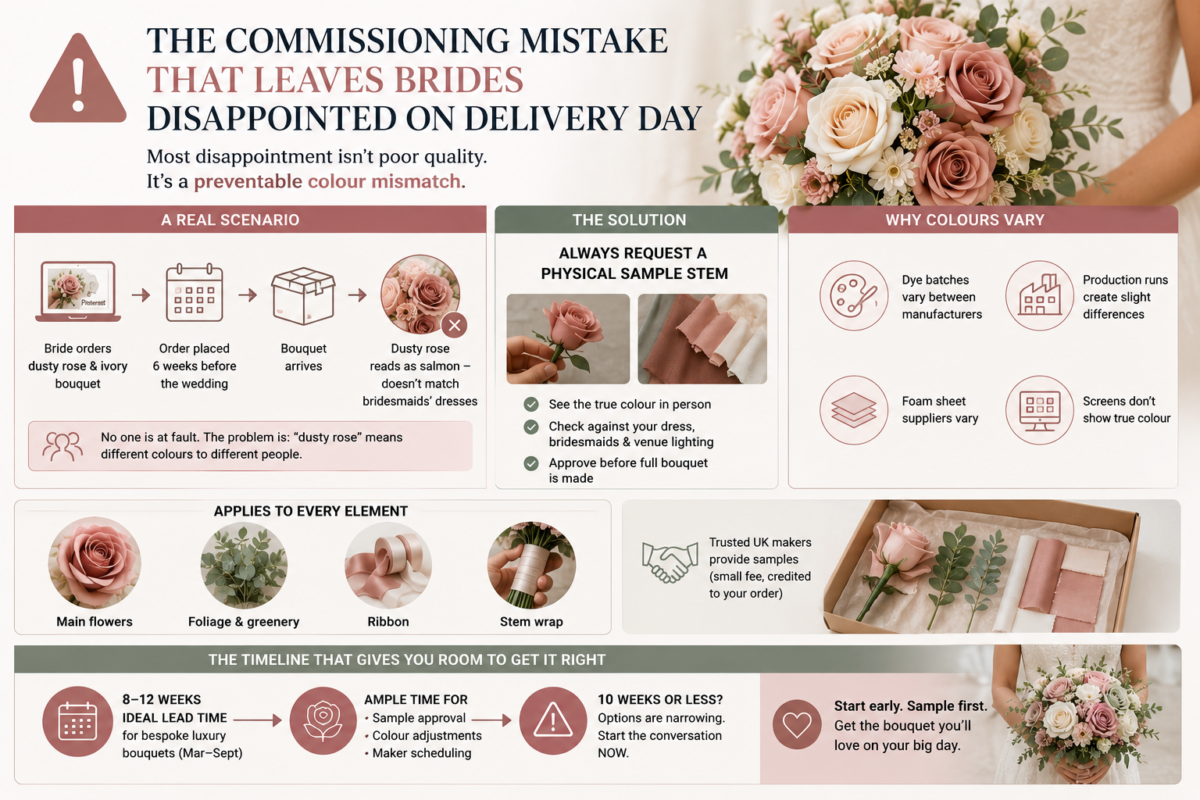
The most consistent source of disappointment I see among brides who ordered luxury artificial wedding bouquets UK-wide is not poor quality, it is a colour mismatch between what was ordered and what arrived. And in almost every case, the mismatch was predictable and preventable.
Consider a real scenario: a bride orders a dusty rose and ivory foam bouquet from a highly rated Etsy maker, six weeks before her wedding. She sends a Pinterest board, the maker agrees the colours look achievable, and the order is placed. The bouquet arrives, and the dusty rose reads as salmon different enough to clash with the blush bridesmaids’ dresses she has already ordered. Neither party acted in bad faith. The problem was that “dusty rose” described two different colours from two different reference points, and no physical sample was requested or provided. Colour in artificial flowers is determined by dye batch, and dye batches vary between manufacturers, between production runs, and between individual foam sheet suppliers. A maker using one foam sheet supplier’s “blush” will produce a noticeably different result from a maker using another’s, even if both label it identically. The only reliable colour verification for a custom artificial wedding bouquet UK order is a physical sample stem sent to your home, held against your actual fabric swatches, in your venue’s lighting conditions or the closest approximation you can achieve.
This applies to every element of the bouquet, not just the main flower. Foliage greenery varies between blue-green, yellow-green, and grey-green across different artificial leaf products. The ribbon colour needs to be matched to your dress, not to a screen-based colour picker. None of this can be done reliably without physical samples in hand, and the most trustworthy UK makers will send them, usually for a small fee that is credited to your order on purchase.
The six-week timeline is also worth examining honestly. Most specialist UK makers of handcrafted foam bouquets quote 8–12 weeks for a full bridal set during peak wedding season (March–September). A six-week lead time for a bespoke luxury piece during this window is tight. It leaves no room for sample revision, colour correction, or the inevitable scheduling delays that affect small independent makers. If your wedding is within 10 weeks and you haven’t started a commission, your options are narrowing. Start the conversation now, even if you’re not ready to place the order.
How to Evaluate and Choose a Luxury Artificial Wedding Bouquet
Rather than browsing product pages until something looks right, I recommend a four-step framework before contacting any supplier. This applies whether you’re spending £150 or £450.
Step 1 — Decide your style before contacting any maker. Cascading and trailing bouquets require significantly more construction time and material than a round posy, and therefore a longer lead time and higher cost. If you don’t arrive at a maker’s enquiry form knowing your approximate style preference, the commission process starts with a broad conversation that could narrow to the wrong design. Spend 30 minutes on Pinterest before making first contact, with a specific board that shows style, colour palette, and scale separately.
Step 2 — Request a sample before committing. As described above, this is non-negotiable for a colour-matched commission.
Step 3 — Ask the four quality questions. Material (foam or polyester?), petal construction (hand-shaped or machine-cut?), stem construction (wire armature or hollow?), and origin of foam materials (UK or European supplier vs. generic wholesale?). The last question matters because foam quality varies significantly and affects both the finished look and the long-term durability of the bouquet as a keepsake.
Step 4 — Check the revision and delivery policy. A reputable maker includes at least one revision round in the commission price, the ability to adjust the sample before the full bouquet is made. Understand what happens if the delivered bouquet doesn’t match the approved sample. Any maker confident in their process will have a clear position on this.
| Option | Best For | Key Tradeoff |
| Specialist UK Etsy foam maker (handcrafted) | Bespoke, colour-matched, photography-grade luxury | Longer lead time; premium cost; requires sample process |
| Established UK artificial flower retailer | Reliable mid-tier quality, faster turnaround | Less customisation; stock colours only; not true handcrafted |
| Budget polyester online supplier | Decorative elements not in close-up photography | Will not pass as real in professional wedding photographs |
| International foam flower importer (Alibaba/wholesale) | DIY brides assembling their own bouquet | Significant skill and time required; quality consistency varies |
| Mixed fresh and luxury artificial | Best of both worlds — real statement flowers with artificial longevity elements | Two suppliers to coordinate; colour matching across mediums is complex |
What Changes Depending on Your Wedding Situation
The right approach to a luxury bridal bouquet UK shifts considerably based on four variables that most articles treat as irrelevant.
Your wedding date and season. Summer weddings (May–August) represent peak demand for specialist UK artificial flower makers. Commissions placed in January for a June wedding will access the full maker marketplace. Commissions placed in April for a July wedding will find most quality makers already booked. If your wedding date is in peak season, the timeline for securing a quality commission is earlier than you probably think.
Destination weddings. A significant and growing proportion of UK brides ordering luxury artificial wedding bouquets are marrying abroad in Italy, Greece, Cyprus, or France, specifically because realistic artificial wedding flowers UK makers produce travel-ready arrangements that arrive at destination venues in perfect condition. Fresh flowers at destination weddings involve florist sourcing in a foreign language, import restrictions in some countries, and the risk of wilting in summer heat before the ceremony. A well-packaged artificial bouquet in a rigid travel case eliminates all of these variables.
Venue and photography style. Outdoor ceremonies in direct summer sunlight are the most demanding environment for artificial wedding flowers of any quality tier. If your ceremony is outdoors in full sun, only the highest-grade handcrafted foam flowers will look convincing in photographs. A mid-tier artificial bridal bouquet UK that looks excellent in an indoor venue can look noticeably synthetic in bright outdoor light. Discuss your venue and ceremony timing with your photographer before finalising the bouquet choice.
Keepsake intention. Long-lasting wedding bouquets are one of the primary reasons UK brides cite for choosing artificial over fresh. A handcrafted foam bouquet stored in a UV-protective display case will look identical in twenty-five years. A fresh bouquet requires professional freeze-drying (£350–£600 in the UK) with unpredictable colour preservation. If keeping the bouquet matters to you, factor this into the budget comparison; the total cost of fresh flowers plus preservation frequently exceeds the cost of a luxury artificial bouquet at the outset.
Common Mistakes That Undermine a Luxury Artificial Wedding Bouquet
Ordering a product from a photograph without requesting a physical sample. This is the single most consequential mistake in this purchase category. Product photographs of artificial flowers are taken under controlled studio lighting that deliberately suppresses the surface sheen of lower-quality materials and flattens the colour variance that will be visible in your venue. A physical sample seen in your home, in your venue’s lighting, against your dress fabric, this is the only reliable quality test. Any supplier who refuses to provide samples or charges unreasonably for them is a supplier who knows their product won’t pass the test.
Treating all foam flowers as equivalent. “Foam flowers” is now used as a marketing term by budget suppliers who produce machine-cut foam pieces that are a step above polyester but nowhere near handcrafted quality. When a supplier describes their flowers as foam, ask specifically whether petals are individually hand-shaped. The answer immediately clarifies the quality tier.
Leaving insufficient lead time for a full bridal set. A bride ordering only her own bouquet has more flexibility than a bride ordering a coordinated set of bouquets, three bridesmaids’ posies, buttonholes, flower crowns, and table centrepieces. A full set from a specialist UK handcrafted foam maker requires 10–16 weeks minimum during peak season. Starting this process at the same time you book your photographer (9–12 months before the wedding) gives you the widest maker choice and the most revision time.
Assuming “luxury” price guarantees luxury quality. Several UK artificial flower retailers have positioned themselves at premium price points with high-quality website design and marketing photography while continuing to source polyester or low-grade foam flowers from wholesale suppliers. The price-to-quality correlation in this market is weak. The four questions in the evaluation framework above are the only reliable quality verification; price is not.
Do not discuss the bouquet with your photographer. Your photographer’s lighting approach determines whether your artificial flowers look real in your wedding photographs. A conversation before the wedding, showing them the bouquet sample and asking how they’ll approach bouquet shots under your venue’s specific lighting, can prevent the single most common source of disappointment: beautiful flowers that photograph poorly because nobody planned for their specific material properties.
The Detail That Separates the Best UK Makers From the Rest: The Petal Ageing Technique
I want to tell you about something the best UK handcrafted foam bouquet makers do that no product listing mentions and no competitor article has written about because it is the detail that, more than any other, explains why some artificial wedding bouquets genuinely fool florists and why others don’t.
The technique is called petal ageing, and it involves applying subtle colour variation to individual petals after the initial dye dusting the edges in a slightly deeper shade, lightening the centre with a dry-brush technique, and occasionally adding a faint vein mark in a contrasting colour. Real flower petals are not a single uniform colour. They have variation from the base to the tip, between the surface and the underside, and across individual petals within the same bloom. Machine-produced artificial flowers, by contrast, are a single consistent colour throughout, which is one of the primary visual signals that reads as synthetic to a trained eye, and sometimes to an untrained one.
The best specialist makers in the UK apply petal ageing as standard for luxury commission work. It adds time to the construction process, which is part of why genuine handcrafted luxury bouquets from UK specialists cost what they do. When you enquire with a maker, asking “do you apply any colour ageing or shading to your petals?” will immediately tell you whether you are speaking with a true specialist or a general maker using the word luxury as a price bracket.
Paired with the correct photography conditions, a petal-aged handcrafted foam bouquet from a UK specialist is, in my experience, the artificial wedding product most consistently indistinguishable from fresh flowers in professional photographs. This is not an exaggeration it is a manufacturing outcome that is achievable and verifiable before you commit to an order.
The Honest Answer: What Nobody Tells You About the Artificial Bouquet Market in the UK
Here is the tradeoff I haven’t yet made explicit, because it cuts against the grain of what every supplier wants you to believe: a genuinely luxury handcrafted artificial wedding bouquet from a UK specialist costs more than most brides’ budgets for it and costs less than most brides think when compared correctly.
The comparison most brides make is artificial versus fresh at the same price point. The comparison that actually reflects the decision is: handcrafted artificial bouquet at £250–£400 versus fresh flowers from a UK florist at £400–£700, plus freeze-drying for preservation at £350–£600, plus the reality that fresh flowers at a summer outdoor wedding in direct sun will wilt noticeably within three hours.
When brides put those numbers together honestly, the luxury artificial bouquet becomes the financially rational choice, not the budget compromise. The problem is that the artificial flower market has spent years marketing itself as the affordable alternative rather than the premium alternative, which has trained buyers to expect it to be cheaper when the top-tier product is simply differently priced.
My honest position: if you want a keepsake-quality bouquet that photographs convincingly, holds up through a full wedding day, and looks identical in ten years, a handcrafted foam bouquet from a UK specialist is the correct product. The question is not whether it’s worth the premium — it is. The question is whether the specific maker you’re considering is genuinely working at that level, or using the word luxury to justify a standard price increase on a standard product.
Commission Your Luxury Bouquet With Confidence
You know what real luxury looks like now and what questions to ask before committing. Browse our handcrafted artificial wedding bouquet collection, request a sample to test in your venue’s light, and start your commission with a maker who can answer every question in this guide specifically and without hesitation.